
Tumbleweed raises €6.9 million in Austria's largest SpaceTech seed round
The round is led by early-stage investor PactVC, with participation from Munich-based Vanagon Ventures, Prototype Capital, which had already invested in Tumbleweed at an early stage, EWOR and a group of international investors and business angels. More than a third of Tumbleweed's 25-person team has also invested its own money in the company. It is the largest seed round in the history of Austria's SpaceTech sector to date.
This financing allows us to scale what we proved with our first mission, Oasis Alpha: that microgravity can be a widely available industrial resource.
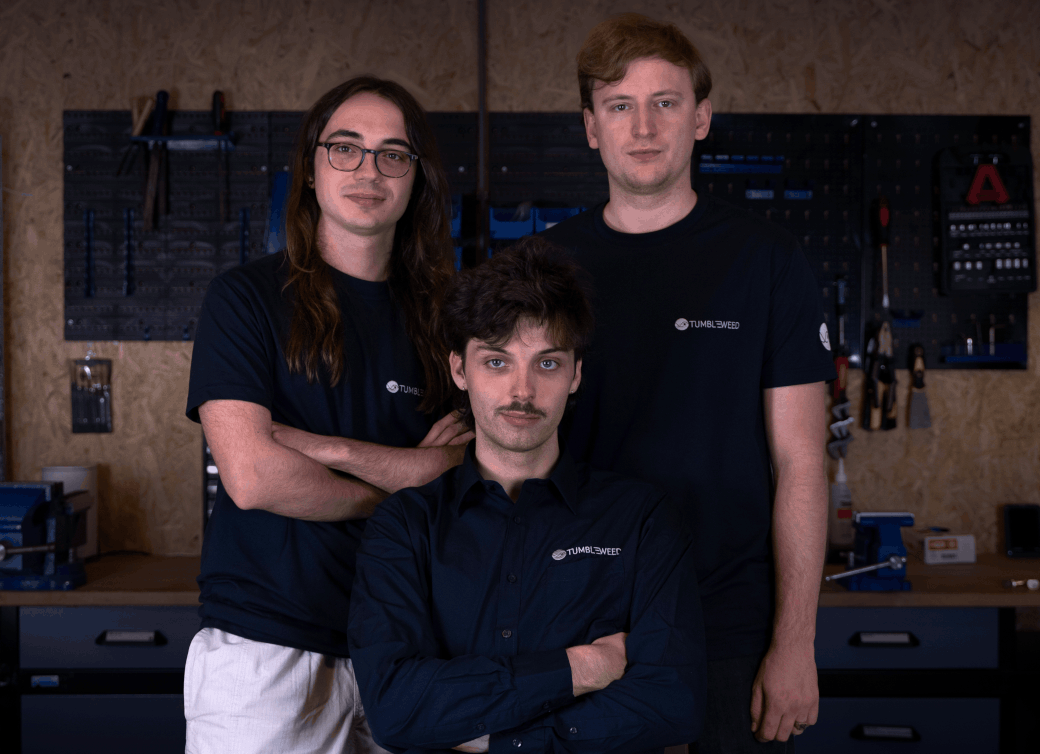
Instead of years of preparation to get a satellite into space, you simply order one of their boxes.
From Mars rover to microgravity
The company's roots go back to 2016, when Team Tumbleweed was formed: an initiative in which more than 30 people worked on a rover concept for Mars.
Such work depends on tests and experiments. Yet in conversations with researchers, the team kept running into the same problem: experiments in weightlessness have been carried out for more than 50 years, but access to microgravity remains slow, expensive and barely possible for organisations outside the traditional space sector.
In 2024, this insight led to the spin-off of Tumbleweed Microgravity as an independent company.
Into orbit without the additional certification hurdle
According to CEO and co-founder Julian Rothenbuchner, the real bottleneck is certification: qualifying an experiment for spaceflight typically takes years. This is where Tumbleweed's so-called "pods" come in: fault-isolating payload containers that are already pre-certified and supply experiments in orbit with power and data links.
We have the satellite and the container certified in such a way that the payloads going into them no longer need to be certified separately.
Research groups, manufacturers and R&D teams therefore send their payload directly to Tumbleweed and then receive the relevant data from space during the flight. On the first mission, Oasis Alpha, these included a cell biocatalysis experiment by the company Mass Balance, research by the European Space Resources Innovation Centre (ESRIC) into phase transitions relevant to future resource extraction in space, and tests of autonomous intelligent systems by TU Delft.
From 2028, the pod itself is set to return to Earth on every mission. Compared with equivalent experiments on the International Space Station (ISS), Tumbleweed's customers fly five times faster and at a tenth of the cost, according to the company. Missions can be booked from as little as €15,000. For all of the company's customers to date, it was the first time their payloads had flown to space.
Tumbleweed's first orbital platform, Oasis Alpha, was built in just nine months and launched into space on 7 July 2026 aboard SpaceX's Transporter-17 mission, carrying a total of four customer payloads. The mission was fully booked a year before launch.
Today, according to Rothenbuchner, around half of its customers approach the company on their own initiative; for Oasis Beta, the figure is two thirds. When it comes to launch vehicles, Tumbleweed deliberately stays flexible, using whichever launch opportunities arise fastest.
Between Delft and Vienna
The 25-person team is split across two sites. In the Dutch city of Delft, which offers a dense network of technical talent, the focus is on technology development. Vienna is home to customer support, mission operations, scientific payload support and the legal team, and increasingly also customer-facing engineering. All testing for the first mission, Oasis Alpha, also took place in Austria.
Rothenbuchner stresses that the support from the Federal Ministry for Innovation, Mobility and Infrastructure (BMIMI) was very good and that the licensing process as a whole was very fast by international standards.
The licensing was outstanding. I really want to emphasise that. The Vienna site is also currently growing considerably faster than Delft, partly because international applicants prefer Vienna. The Vienna team is set to grow by around 70% by the end of 2026.

The fact that Austrian space technology is mobilising international private capital and is already being deployed commercially in space is an important signal for our research and business location. Companies like this strengthen domestic value creation, create skilled jobs and demonstrate that Austria is internationally competitive in demanding future technologies.
Three missions planned for 2027
With the new capital, Tumbleweed is funding three missions in 2027 with a total of more than ten customers. The payloads come from laboratories in medical research, biotechnology and agricultural technology.
The funding round will also accelerate the development of Oasis Beta, the next-generation orbital platform. Planned for 2028, it is designed to carry larger payloads and then bring them safely back to Earth. Bookings for the three 2027 missions and for Oasis Beta are already open. In 2027, Tumbleweed also plans to expand its offering in Austria and says it is already in talks with domestic customers.
Rothenbuchner himself thinks in much longer timeframes. Building microgravity into an industrial resource is a project for the next ten years, he says. The long-term goal is to use microgravity "for ten times better cancer therapies, ten times better semiconductors and ten times faster pharmaceutical development".