
R-Space presents its first satellite fully developed, built, and operated in Austria
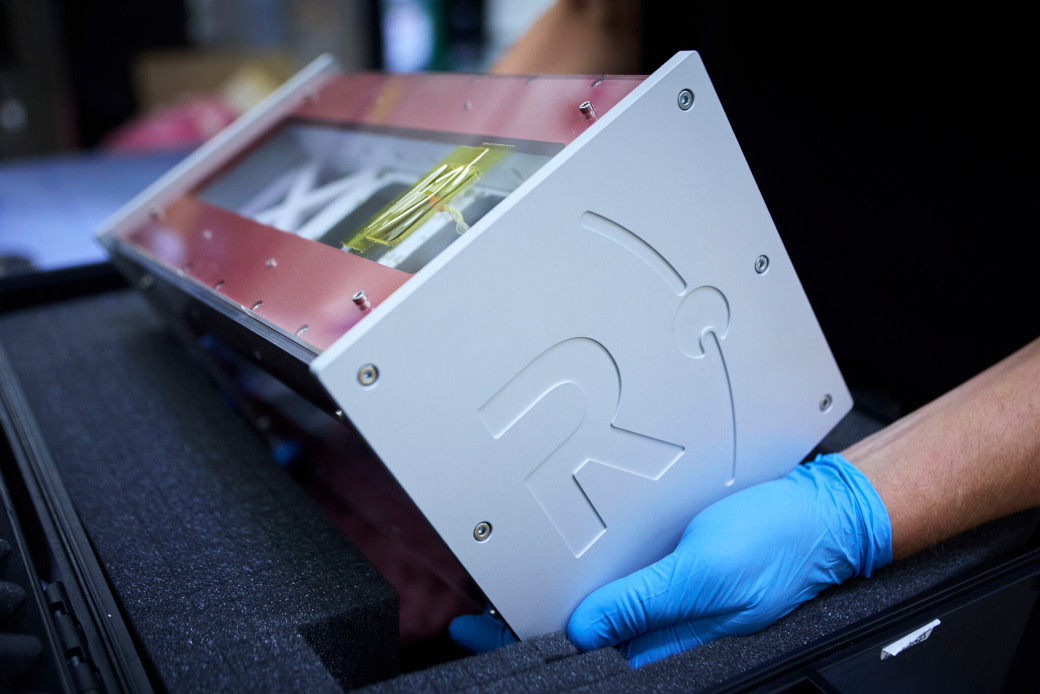
R-Space, the Vienna-based NewSpace company, announced AT-Astra, its first fully developed satellite mission and the first commercial satellite to be designed and built entirely in Austria. Scheduled to launch in autumn 2026 aboard the third flight of Isar Aerospace's Spectrum rocket from the spaceport in Andøya, Norway, AT-Astra carries in-orbit demonstration experiments from three customers and marks R-Space's transition from development to operational spaceflight.
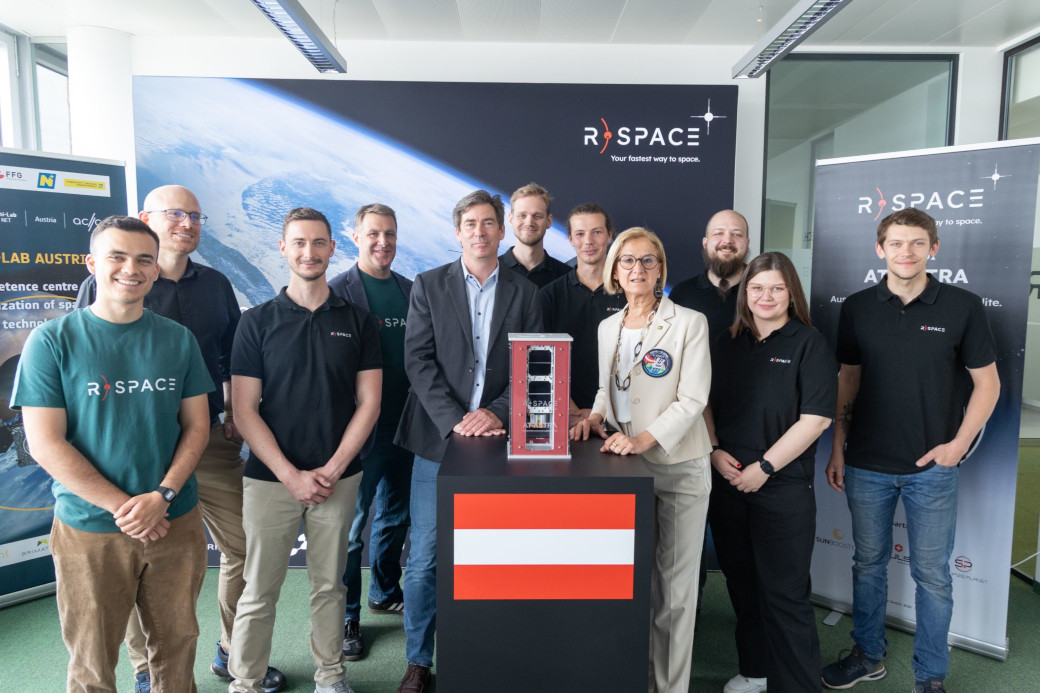
The mission provides an important impulse for Austria as a business and technology location and raises the international profile of its domestic space industry.
As the first commercial satellite developed and built entirely in Austria, AT-Astra marks the start of a new era for Austrian spaceflight. Proving ourselves in orbit is a huge milestone. It shows that Austria can design, build and fly commercial satellites on its own It also confirms R-Space’s capability to deliver complex satellite missions from end to end. With the demand we have today, this is the beginning of a long flight manifest.
Three customers on board
AT-Astra carries experiments from three customers: the Austrian companies ENPULSION and SunBooster, and the Portuguese firm Synopsis Planet. For all three partners, the mission is an important step toward bringing their technologies to market.
- ENPULSION: one of the world's leading providers of electric propulsion systems based on Field Emission Electric Propulsion (FEEP) technology. On AT-Astra it supports the OOBI project (On-Orbit Behaviour of Indium), heating samples of indium, the propellant used in its FEEP thrusters, to their melting point to observe how liquid metal behaves in microgravity, with images downlinked via the R-Space Greenbox platform.
- SunBooster: the Graz-based company is testing a newly developed solar module in orbit for the first time. Its design combines surface-mount (SMT) micro solar cells with mini blocking diodes to improve resilience against micrometeorites while keeping costs low, targeting a tenfold cost reduction compared with existing space solar modules.
- Synopsis Planet: a compact, high-performance star tracker that combines precise attitude determination and space-debris detection in a single unit. Developed with the University of Lisbon and funded by PRR New Space Portugal, it processes data on board for real-time star identification and moving-object detection, simplifying spacecraft architecture and reducing downlink needs.
Even before launch, R-Space achieved one of its central goals: completing an in-orbit demonstration in under six months. The collaboration with Synopsis Planet began only in early January 2026, and integration was successfully completed by the end of May. This short lead time underlines how efficiently and customer-focused R-Space can deliver in-orbit demonstrations, helping to simplify access to space, shorten development cycles and bring innovations to market faster.
Two further missions are already in active preparation for 2027, and the company is in discussions with numerous industrial and institutional partners about additional future missions.
About R-Space
R-Space was founded in 2021 by space researchers Carsten Scharlemann, Christof Obertscheider and Wolfgang Treberspurg with a shared goal: to make access to space simpler, faster and more economical. Together, the founders bring more than 40 years of experience in developing space technologies. The company gives businesses and research institutions fast, straightforward access to in-orbit demonstrations (IODs) to test new technologies under real conditions in space.
R-Space offers an end-to-end service from a single source, supporting customers from initial technical consulting and payload integration through to launch and in-orbit operations. A team of nearly ten highly qualified specialists develops several satellite platforms for civil and security applications, including high-resolution Earth observation and the space-based detection and localisation of GPS jammers.
Acknowledgements
A mission like this is not possible without the support of many people, institutions and partners. R-Space thanks the Austrian Research Promotion Agency (FFG), the Federal Ministry for Innovation, Mobility and Infrastructure (BMIMI), the Commercialisation Gateway team of the European Space Agency (ESA), ESA Phi-Lab Austria, the association STG-A and Flughafen Wien AG, operator of the Space Hub at Vienna Airport, for their belief in R-Space's vision and their support.