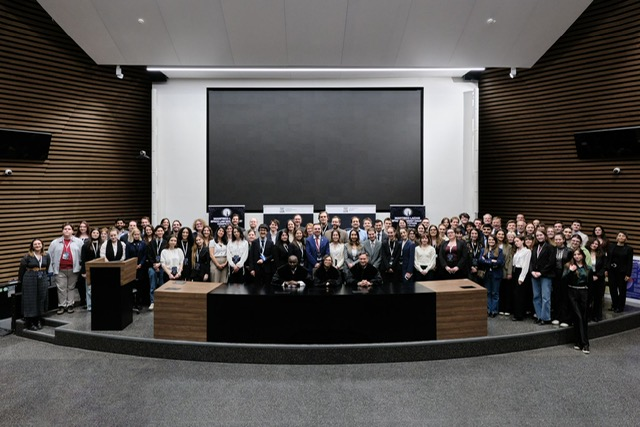
Manfred Lachs Space Law Moot Court – European Final in Poland
The focus was on the responsibility and liability of states for space activities carried out by "non-governmental corporate actors". The ongoing privatisation of space activities and the operations of companies such as SpaceX and Blue Origin raise these questions also in the real world today. NASA's Artemis programme, as well as similar projects by China and other states on the Moon, provide a further topical connection. One aspect of the case also concerned the active removal of space debris without the owner's consent.
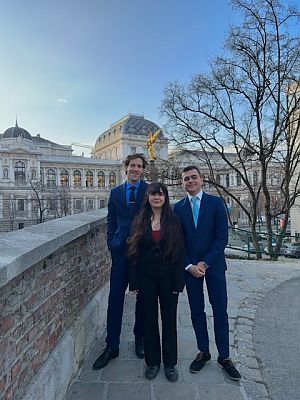
The University of Vienna team for the Manfred Lachs Space Law Moot Court consisted of Jana Félice Sorz, Domonkos Varga and Simon Ruhaltinger. They were supervised by Celina Saci, Adela Zinschitz and Friederike Lutz at the Institute for European, International and Comparative Law, under the guidance of Professor Irmgard Marboe.
Between October 2025 and February 2026, the team worked on the written submissions for the International Court of Justice in The Hague, where the case was to be heard. Then, preparations for the oral rounds followed. While practising their pleadings in English, the team was supported by other members of the Institute, who contributed their experience from other international moot court competitions (Jessup International Law Moot Court, Frankfurt Investment Arbitration Moot Court).
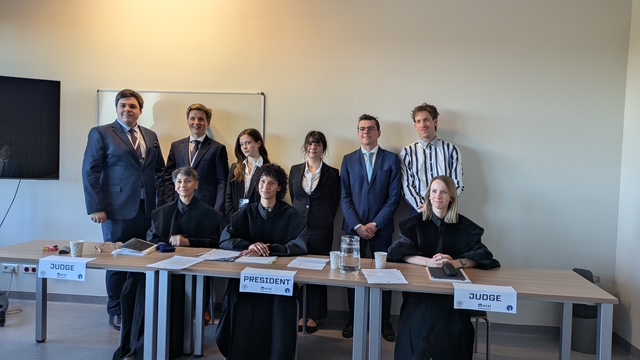
At the European Rounds in April 2026 in Poznań (Poland), the team from Vienna faced teams from universities in Leiden, Istanbul, Sofia and Warsaw. The participation provided not only an opportunity to exchange carefully crafted legal arguments and demonstrate rhetorical skills, but established also valuable contacts. In the end, the University of Vienna team finished in fifth place and was ranked seventh overall among 24 participating universities.
While international competitions may appear to focus primarily on the competitive aspect, in the end working towards shared goals as a team and the search for solutions to cross-border problems provide the most lasting experiences. This intensive engagement not only fosters cooperation within the team, but also beyond.