
Satellives: The Next Generation of Space Infrastructure
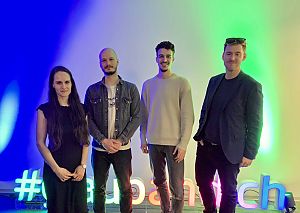
Lilly Eichinger, founder and CEO of Satellives, found an unusal way into space entrepreneurship. Born in Budapest, she first studied philosophy and fine arts, then architecture, and eventually technical physics in Vienna. Trained as an architect with a lifelong fascination for space, she long dreamed of designing settlements on the Moon or Mars, until she realized that before humans could live and work there, space infrastructure must be put there first.
The decisive impulse came during the Extended Studies on Innovation program at the Technical University of Vienna. That's where the idea for her Startup began to take shape, supported by mentors, colleagues, and an environment that encourages interdisciplinary thinking.
From this experience, and from understanding a fundamental problem, Satellives was born: a Vienna-based startup developing modular, reconfigurable satellite platforms designed for in-orbit manufacturing, data storage, energy production, and other missions. Founded around two and a half years ago, the company has grown from Eichinger's solo idea into a small international team, working alongside her brother, an electrical engineer and economist, and a technical co-founder with experience in satellite systems.
Rethinking Satellites
The core innovation of Satellives is the so-called FlatSat, a thin, panel-like satellite that unfolds in orbit. Each module can operate independently or connect with others to form larger platforms. This design overcomes the limitations of traditional CubeSats and allows multiple missions to run on a single system.
We’ve redefined what a satellite actually is. Why shouldn’t one platform be able to perform multiple functions at the same time?
FlatSats work similarly to solar panels: they generate and store energy while simultaneously serving as data storage units. Other small satellites, such as CubeSats, can dock onto the Satellives platform via a plug-in interface and draw power and data connections directly. This eliminates the need for each satellite to carry its own solar panels, batteries, or communication modules.
Each module measures about 33 by 33 centimeters when unfolded and only three centimeters thick when stacked. The satellites are compatible with standard dispensers, reducing launch costs. Satellives has filed several patents for the system, including for the modular hinge design and for production boxes that can host 3D printers, laser systems, or biotechnological experiments.
A Platform Economy in Orbit
Satellives' technology enables a new kind of orbital infrastructure: part energy grid, part data center, part factory. The business model foresees that customers can either purchase their own FlatSats or subscribe to access the existing infrastructure. Revenue streams range from leasing and usage fees to shared returns from in-orbit manufacturing or data services.
It’s like cloud storage but literally above the clouds. We’re creating a platform economy in space.
In the future, users will be able to book energy, data storage, or production capacity through an online platform, similar to terrestrial cloud services. This opens opportunities for research institutions, small satellite operators, and companies that need access to orbital infrastructure without having to build expensive large satellites. According to Eichinger, interest already exists: several letters of intent with potential partners in 3D printing, materials research, and laser communications are expected to be signed soon.
A Circular Economy in Space

But Eichinger's vision goes beyond energy and data. Satellives aims to build a fully circular space infrastructure – a system where satellites no longer burn up at end-of-life but are repaired, reused, or recycled in orbit.
Every FlatSat can detach damaged parts and fold them into an empty production box for repair or return to Earth. The modular design allows maintenance and replacement directly in space—"the opposite of disposable space technology," Eichinger says. "We want to make orbital infrastructure sustainable. No more satellites drifting around or burning up. Every part should have a second life."
In the long term, Satellives wants to close the materials loop: satellites manufactured automatically on Earth could one day be refurbished with recycled components from space. "Our goal is a self-sustaining system," says Eichinger. "Infrastructure that repairs itself, produces itself, and powers itself—without leaving waste behind."
Production in Austria
A FlatSat is expected to cost around €100,000, which is affordable enough to give small research institutions and universities access to space. Customers can purchase a single module or join a larger network to share computing power and energy. Production is planned in Vienna, using an automated assembly line. A first prototype is scheduled for testing in 2026, with two units to be launched by 2028.
We want to become the first satellite manufacturer headquartered in Austria. There are great companies here that supply components, but nobody builds complete satellites.
Satellives currently operates from the Makerspace in Tulln and the Vienna Space Hub, collaborating with research partners via the ESA Phi Lab and the Accent incubator program. Patent applications are underway, funding proposals are being prepared, and discussions with investors will begin once the first prototype is ready.
Austria's Contribution to Space Technology
For Eichinger, Austria is a promising, though still underestimated, location for space companies. "When people think of space, they rarely think of Vienna," she says. "But the ecosystem is growing fast. Austria has a lot of talent and has produced several successful international space companies."
Her outlook remains pragmatic and optimistic: "The world is small today. Whether you're in Vienna, Budapest, or Glasgow, you can build global technology. What matters is collaboration," she says. "For me, it's not about quick exits, but about building something lasting: a real, sustainable space infrastructure."