
GATE Space Wins € 6.3 Million from the European Commission
GATE Space was the only company from the space, aerospace, and defense sectors selected by the European Commission's expert jury in the current funding round.

The funding marks a major milestone in the company's development and lays the foundation for its next phase of growth. The proceeds will be used to accelerate the industrialization of GATE Space's patented technology, expand production capacity, and further strengthen the company's international market position.
This funding is an extraordinary validation of our technology, our team, and our vision. It enables us to significantly accelerate our growth strategy and further strengthen our position as a leading provider of mobility and infrastructure solutions in space.
One of Europe's Most Selective Deep-Tech Funding Programs
The EIC Accelerator is the flagship program of the European Innovation Council (EIC) and ranks among the world's most selective funding and investment programs for deep-tech companies. In the previous funding round, only around six percent of applicants were selected for financing.
The program targets companies with validated technologies and strong scaling potential, combining non-dilutive grant funding with equity investments from the European Union. The multi-stage selection process includes evaluation by independent experts, comprehensive technical, commercial, and financial due diligence, and a final investment pitch before an international jury of investors, entrepreneurs, and technology experts.
Advanced Chemical Propulsion Systems
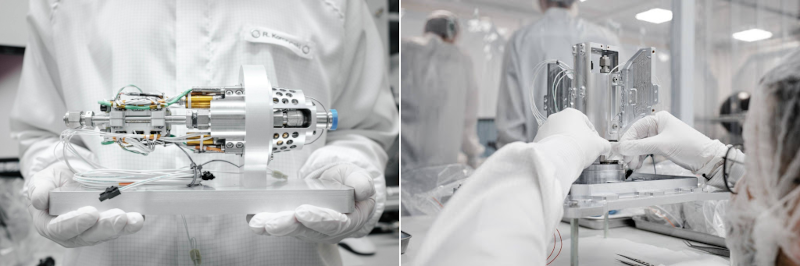
GATE Space develops mobility solutions for satellites, helping lay the foundation for a new generation of European space infrastructure. The company's technologies enable mission-critical capabilities such as agile orbit transfers, collision avoidance, precision docking maneuvers, and controlled deorbiting, significantly improving the performance, safety, and operational lifetime of satellites.
GATE Space already works with leading institutional and commercial partners and has secured four contracts with the European Space Agency (ESA). A prominent example is the ESA ASTRAL (Advancing Satcom Technology with Refuelling and Logistics) mission led by Orbit Fab, a prominent US- and UK-based space logistics company with backing by the US Space Force.
The mission will demonstrate autonomous docking and propellant transfer between two satellites — a critical capability directly strengthening Europe's strategic resilience across both commercial and defense space architectures. GATE Space will provide all high-performance propulsion capabilities enabling rendezvous and proximity operations (RPO) and the controlled transfer of propellants between multiple satellites.
In addition, GATE Space is leading the development of BEACONSAT, Austria's first military satellite, which will detect and analyze jamming and spoofing attacks on satellite navigation systems such as GPS and Galileo from orbit.
About GATE Space
GATE Space is an Austrian space company with offices in Vienna, Lower Austria, and San Francisco. Founded in 2022 by graduates of the Vienna University of Technology (TU Wien), the company holds three patent families and operates one of Europe's largest commercial development, testing, and production infrastructures for satellite propulsion systems. Its customers and partners include the European Space Agency (ESA), government institutions, and commercial space companies across Europe and North America.
For the development of the company, GATE Space was able to rely not only on equity investments, but also on the Seedfinancing Deep Tech grant and a guarantee from Austria Wirtschaftsservice, as well as funding from the Austrian Research Promotion Agency (FFG).